
New Paper · 2026
Mei T, Li J, Yang X. Acute doses of 3 and 6 mg/kg caffeine produce outcome- and phase-specific improvements in male 100-m sprinters: a randomized, double-blind, placebo-controlled crossover trial. PLOS ONE. 2026;21(11):e0361864. Published online 10 November 2026. doi:10.1371/journal.pone.0361864. PMID 43008037. PMC13750558.
Last updated 23 November 2026 · Written for US and Canadian readers · medical disclaimer
TL;DR
In 21 trained male sprinters, both 3 and 6 mg/kg of caffeine, taken 60 minutes before testing, beat placebo on 60-m sprint times, jump height, 10-second Wingate power, reaction time, and starting-block force. The higher dose added a bit more on jumps, rate of force development, and cumulative 30- and 60-m times, but not on reaction time, Wingate power, or perceived effort. Side effects were not tracked, so the study can’t tell you whether the extra dose is worth it.
The question
Caffeine is one of the best-supported performance supplements, but “more is better” is a common assumption. Mei and colleagues asked whether the two doses most often used in research, 3 and 6 mg per kg of body weight, help every part of a short sprint and related power tests equally, or whether the dose response depends on the outcome. They ran a randomized, double-blind, placebo-controlled, three-condition crossover trial.
Who
21 male 100-m sprinters from a university sport-training program in Beijing, aged 18–25 (mean 20.0 ± 1.45 years; height 181.0 ± 4.87 cm; body mass 74.0 ± 6.57 kg). All had at least 3 years of systematic sprint training and met China’s national second-class 100-m standard; mean 100-m personal best was 11.00 ± 0.24 s. All 21 completed all three conditions; there were no dropouts or missing data. No women, no older lifters, and no strength athletes were studied.
Protocol
- Conditions: placebo (white flour in identical capsules), caffeine 3 mg/kg, and caffeine 6 mg/kg, as commercial caffeine capsules swallowed with 200 mL of water.
- Timing: warm-up 30 minutes after ingestion; two all-out 60-m sprints at 60 minutes (best kept); then countermovement jump, squat jump, and a 10-second Wingate test, always in that order.
- Washout: at least 7 days between trials. Participants avoided caffeine-containing foods and drinks for 48 hours before each trial.
- Analysis: linear mixed-effects models adjusting for period and sequence, with Holm correction for the three pairwise comparisons.
For scale only (our arithmetic, not a recommendation): at the group’s mean body mass of 74 kg, 3 mg/kg is about 222 mg and 6 mg/kg about 444 mg.
What it found
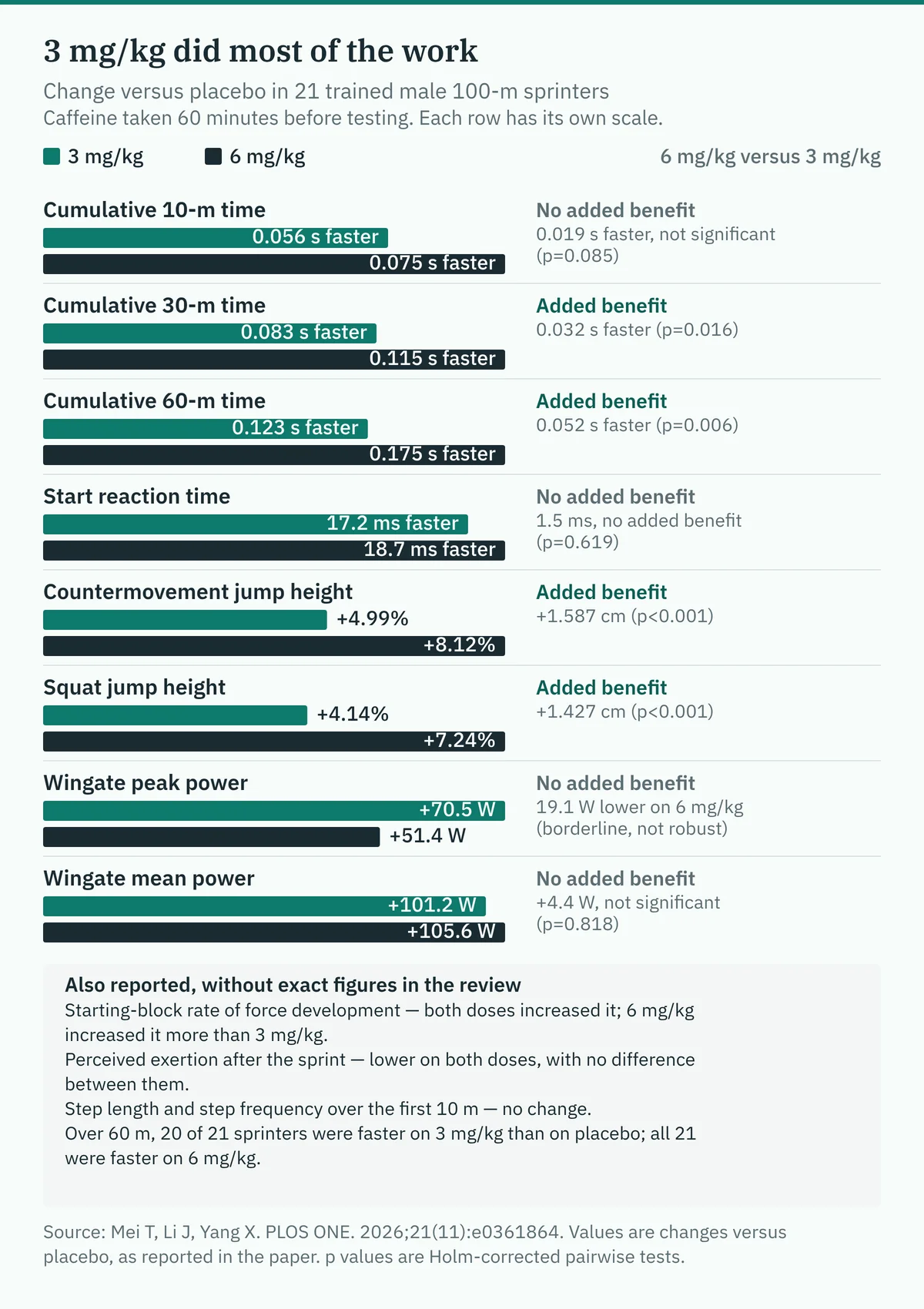
All figures are as reported in the full text, versus placebo unless stated.
| Outcome | 3 mg/kg | 6 mg/kg | 6 vs 3 mg/kg |
|---|---|---|---|
| Cumulative 10-m time | 0.056 s faster | 0.075 s faster | 0.019 s faster, not significant (pHolm = 0.085) |
| Cumulative 30-m time | 0.083 s faster | 0.115 s faster | 0.032 s faster (pHolm = 0.016) |
| Cumulative 60-m time | 0.123 s faster | 0.175 s faster | 0.052 s faster (pHolm = 0.006) |
| Start reaction time | 17.2 ms faster | 18.7 ms faster | 1.5 ms, no added benefit (pHolm = 0.619) |
| Countermovement jump height | +4.99% | +8.12% | +1.587 cm (pHolm < 0.001) |
| Squat jump height | +4.14% | +7.24% | +1.427 cm (pHolm < 0.001) |
| Wingate peak power | +70.5 W | +51.4 W | No extra benefit (6 mg/kg was 19.1 W lower; borderline, not robust) |
| Wingate mean power | +101.2 W | +105.6 W | +4.4 W, not significant (pHolm = 0.818) |
Other results:
- Both doses increased all three starting-block rate-of-force-development measures; 6 mg/kg increased them more than 3 mg/kg.
- Perceived exertion after the sprint was lower on both doses, with no difference between them.
- Step length and step frequency over the first 10 m did not change.
- Over 60 m, 20 of 21 sprinters were faster on 3 mg/kg than on placebo, and all 21 were faster on 6 mg/kg.
- When the 60-m run was split into segments, the two doses did not differ significantly over 10–30 m or 30–60 m.
The authors conclude that 3 mg/kg “was sufficient to improve multiple performance outcomes in this cohort,” while 6 mg/kg added benefits for selected outcomes, so “the dose response was outcome-specific rather than uniformly greater at 6 mg/kg.”
Limits
- Small, specific sample: 21 young male sprinters at one university. No formal a priori power calculation; the authors say smaller differences, especially between the two doses, may have been missed.
- Side effects not measured: adverse effects and blinding success were not systematically assessed, and plasma caffeine was not measured. The authors note that higher doses are associated elsewhere with more insomnia, nervousness, and palpitations, and that caffeine later in the day can impair sleep. This trial cannot weigh benefit against those costs.
- Fixed test order: jumps and Wingate always came after the sprints, so those are post-sprint measures, not fresh ones.
- Sprints stopped at 60 m. Nothing about the last 40 m of a 100 m, lifting 1RM, or volume work.
- Registration: the trial was registered retrospectively (ChiCTR2600128594); the authors state that procedures and outcomes were not changed after enrollment began.
- Habitual intake was recorded but not tested as a moderator. Time of day was matched within each athlete but not set relative to wake time.
- Funding and conflicts: funded by Chinese government research grants; the authors declare no competing interests.
What this does not mean
- It does not show that 6 mg/kg is “the” dose. For several outcomes, 3 mg/kg did as well.
- It is not a bench, squat, or deadlift study. Jump height and Wingate power are related to lifting power, but they are not a 1RM.
- It does not tell women, older men, or people with heart conditions, anxiety, or sleep problems what to do.
- It does not say anything about safety or tolerability at either dose, and it does not support caffeine for any medical purpose.
- It is not a case for a particular pre-workout product. The trial used plain caffeine capsules.
How this should change the guides
Verdict for lifters: if you already use caffeine before training, this paper supports the lower end of the usual research range as a reasonable place to start. It does not justify automatically doubling up. If caffeine hurts your sleep, that cost is real and this trial didn’t measure it; training and sleep still come first.
We do not have a caffeine evergreen guide yet. If one is added, this paper belongs in its dose section as evidence that the response depends on the outcome. For readers who avoid stimulants or train late, see best stim-free pre-workouts for Canada. Licence status for a Canadian product is a separate question: how to read a Health Canada NPN.
This research post has no product links.
Medical disclaimer
The Level Scoop is not a physician, pharmacist, or dietitian service and does not know your medical history. This article summarizes one published paper; it is not medical advice and is not a claim that caffeine treats, prevents, or cures any condition. Caffeine can raise heart rate and blood pressure and disturb sleep. Talk with a clinician before using caffeine supplements if you are pregnant or breastfeeding, have a heart rhythm problem, high blood pressure, an anxiety disorder, or take medication that interacts with stimulants. Read our full medical disclaimer.