
Hidden Gem · 1996
Hultman E, Söderlund K, Timmons JA, Cederblad G, Greenhaff PL. Muscle creatine loading in men. Journal of Applied Physiology. 1996;81(1):232–237. doi:10.1152/jappl.1996.81.1.232. PMID 8828669.
Last updated 23 November 2026 · Written for US and Canadian readers · medical disclaimer
TL;DR
In 31 men, six days of 20 g/day creatine raised muscle total creatine by about 20%, and 2 g/day kept it there. But 3 g/day with no loading reached a similar ~20% rise over 28 days. Loading gets you there faster; it is not required. When supplementation stopped, levels drifted down and were back at baseline 30 days later. We read the abstract only.
Why this is a gem
Supplement listicles and tub labels often present a loading phase as a step you “must” do. This paper is one of the original sources on loading, and its own conclusion is more modest: 20 g/day for 6 days is “a rapid way” to load, and 3 g/day “is in the long term likely to be as effective.” The paper is often cited for the fast protocol while the slow-and-steady result in the same abstract gets skipped. It also shows that the gain fades after stopping, which is useful context for anyone who thinks a short “loading cycle” lasts.
The question
How fast does muscle creatine rise with different supplement doses, how long does it stay up, and what happens when you stop? The researchers gave creatine at different amounts over different periods and measured muscle total creatine and urinary creatinine.
This write-up is based on the PubMed abstract. Figures below appear in that abstract; we have not opened the full text.
Who
31 men. The abstract does not report age, training status, how the men were split across protocols, or dropouts, so we are not filling those in. No women were studied.
Protocol
As described in the abstract, the men “ingested creatine in different quantities over varying time periods”:
- Rapid loading: 20 g/day for 6 days.
- Maintenance after loading: 2 g/day for a further 30 days.
- Stopping after loading: no further supplementation, followed for 30 days.
- No loading: 3 g/day for 28 days.
The abstract does not mention a placebo group, randomization, or blinding. PubMed indexes it as a clinical trial.
What it found
- After 6 days at 20 g/day, muscle total creatine rose by about 20%.
- 2 g/day kept that higher level for another 30 days.
- Without the 2 g/day, levels gradually declined and were no different from baseline 30 days after stopping. Urinary creatinine excretion rose over that period.
- 3 g/day for 28 days produced a similar ~20% increase, just more gradually.
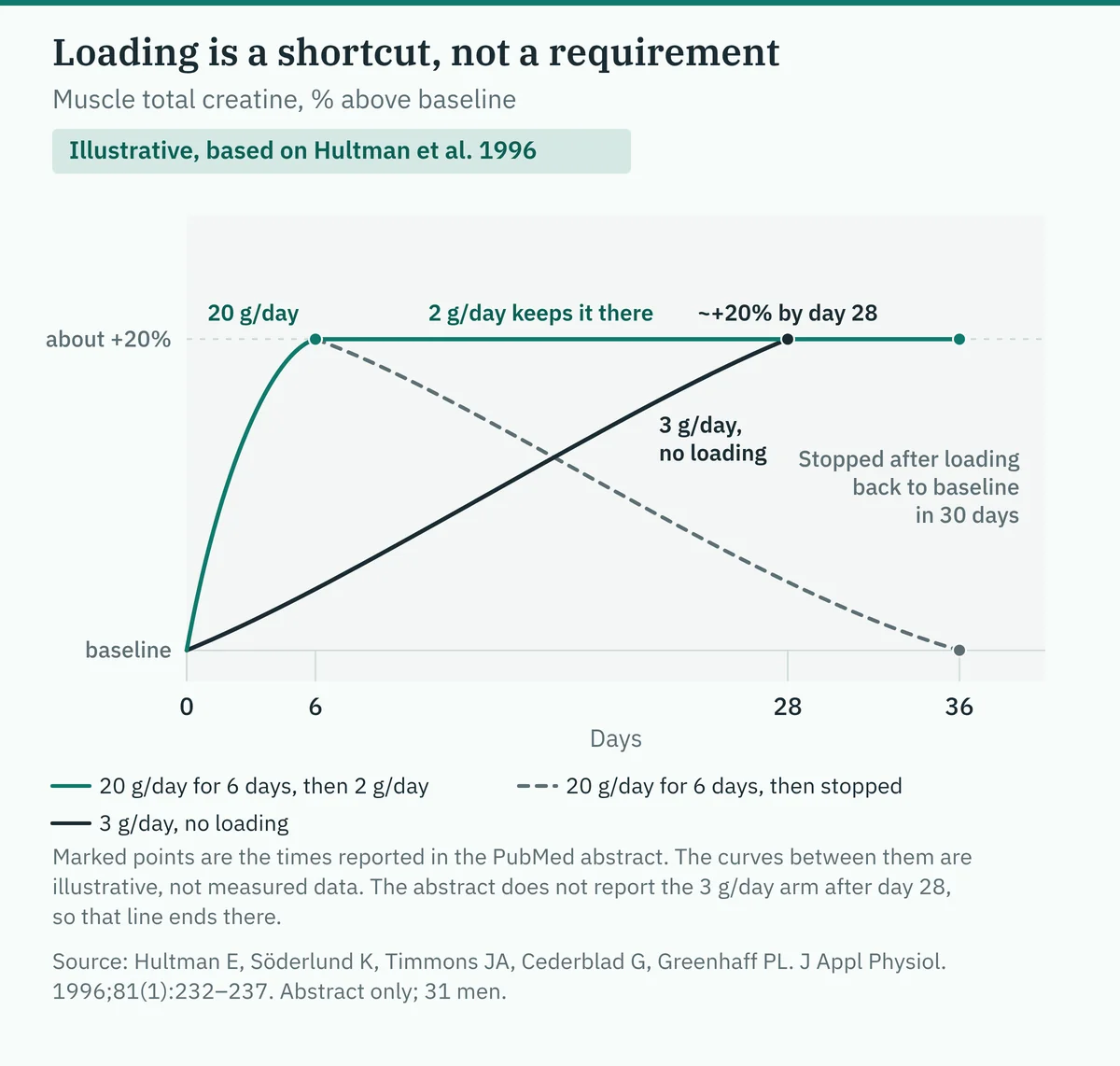
The authors’ conclusion: 20 g/day for 6 days is a rapid way to load muscle, 2 g/day maintains it, and 3 g/day is likely to be as effective in the long term.
Limits
- Abstract only. We cannot report group sizes, variation between people, how muscle creatine was measured, or funding and conflicts.
- Small and old. 31 men, published in 1996.
- Muscle creatine, not performance. The paper measured tissue levels, not strength, muscle gain, or training outcomes.
- No placebo or blinding mentioned in the abstract. This is a physiology study, not a performance RCT.
- Population unclear. We don’t know the men’s ages or training status, so this is not a study of men over 35 specifically.
What this does not mean
- It does not mean loading is useless. Loading reached the same rise faster, which may matter if you want the effect within a week rather than a month.
- It does not set an official minimum or “clinical” dose. The 2 g and 3 g figures are what this study used, not a label standard.
- It does not show performance benefits by itself; that evidence comes from other trials, summarized in our guide.
- It is not a safety study and says nothing about kidneys or hair.
How this should change the guides
What a careful reader takes away: loading is a shortcut, not a requirement. A steady daily dose with no loading reached a similar muscle creatine level in about four weeks. Gains fade within about a month of stopping.
This is consistent with the “loading is optional, not required” section of our creatine guide, which covers current dose ranges, Health Canada’s licensed directions, forms, hair, and kidneys. We link there instead of repeating it: our creatine guide for men over 35. To work out a daily amount by body weight, use the creatine and protein dose calculator. For the hair question, see the related van der Merwe 2009 gem and Lak 2025 new paper when they exist. Creatine still needs training to do anything useful.
This research post has no product links.
Medical disclaimer
The Level Scoop is not a physician, pharmacist, or dietitian service and does not know your medical history. This article summarizes one published paper; it is not medical advice and is not a claim that creatine treats, prevents, or cures any condition. Talk with a clinician before use if you have kidney disease, are pregnant or breastfeeding, or take medication that affects kidney function. Read our full medical disclaimer.