
Guides
Morton RW, Murphy KT, McKellar SR, Schoenfeld BJ, Henselmans M, Helms E, Aragon AA, Devries MC, Banfield L, Krieger JW, Phillips SM. A systematic review, meta-analysis and meta-regression of the effect of protein supplementation on resistance training-induced gains in muscle mass and strength in healthy adults. British Journal of Sports Medicine. 2018;52(6):376–384. Published online 11 July 2017. doi:10.1136/bjsports-2017-097608. PMID 28698222. PMC5867436.
With two supporting papers on per-meal dosing, both checked on PubMed: Moore et al. 2015 (PMID 25056502) and Schoenfeld and Aragon 2018 (PMID 29497353). Full citations are in Sources.
Last updated 25 November 2026 · Written for US and Canadian readers · medical disclaimer
TL;DR
In a 2018 meta-analysis of 49 randomized trials (1,863 healthy adults; mean age 35), adding a protein supplement to resistance training produced a bit more fat-free mass and a bit more 1-rep-max strength than training without the extra protein. Daily protein intakes above about 1.62 g/kg did not bring further fat-free-mass gains, but that breakpoint had a wide confidence interval (1.03–2.20 g/kg/day) and was not statistically significant (p=0.079). The extra benefit of supplementation got smaller with age, and was unclear in the over-45 studies, which often used low doses. Training did most of the work. For per-meal amounts, healthy older men (~71 years) needed more high-quality protein in a single sitting to maximize muscle protein synthesis than younger men (~22 years): about 0.40 vs 0.24 g/kg.
The question
How much daily protein actually adds to what lifting already does, and does that change as you get older? Morton and colleagues pooled randomized trials in which healthy people lifted for at least six weeks, with at least one group given a protein supplement, and asked whether the supplement increased the training-induced gains in muscle mass and strength. They also looked for a daily intake beyond which further protein stopped adding fat-free mass.
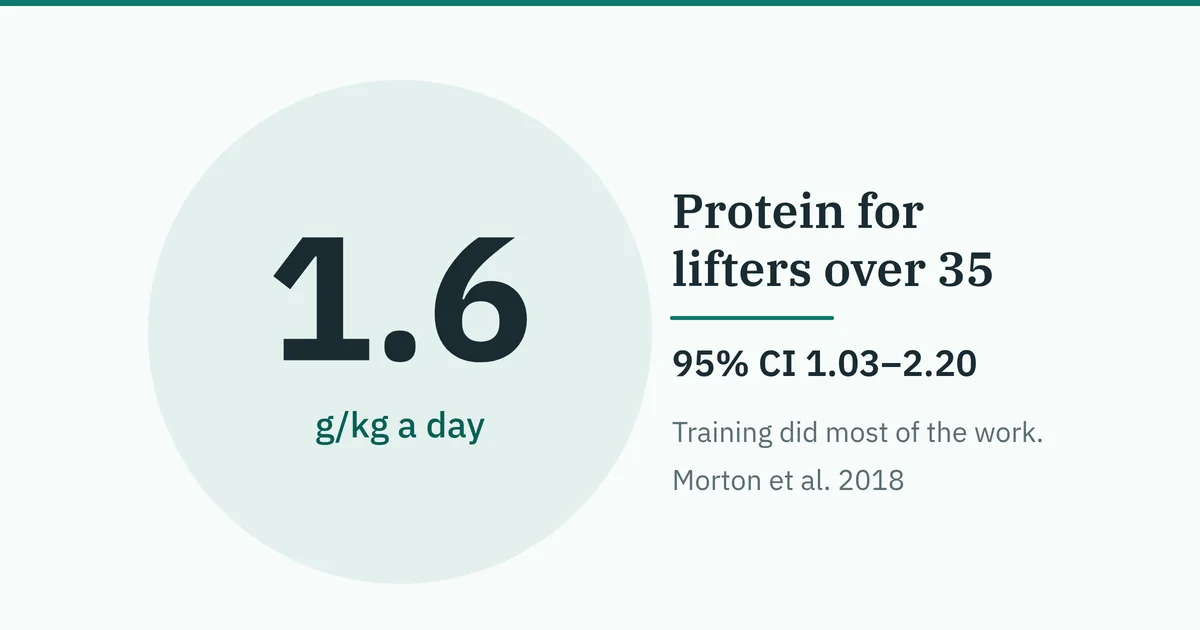
This is not a new paper. It is the dose-response analysis behind the 1.6 g/kg/day figure many lifters already use, including the midpoint in our creatine and protein dose calculator. “Over 35” is our audience, not a cutoff in the paper. The authors’ older subgroup started at age 45, and those participants were typically in their mid-60s.
Who
49 randomized trials, 1,863 participants, from 17 countries, published between 1962 and 2016. Mean age was 35 ± 20 years. Ten studies enrolled resistance-trained people. Fourteen study groups were women only. Trials had to last at least six weeks, with training at least twice a week, in healthy adults who were not in an energy deficit. Supplements that also contained creatine, β-HMB, or testosterone-enhancing compounds were excluded.
Average training block: 13 ± 8 weeks (range 6–52), about 3 days a week.
Protocol
- Comparison: a protein-supplemented group versus a placebo or no-supplement control, both doing resistance training.
- How much protein was added: a wide range, 4–106 g/day (mean 36 ± 30 g/day; 42 ± 32 g/day in younger groups, 20 ± 18 g/day in older groups). Post-exercise doses on training days averaged 24 ± 11 g.
- Sources: whey was the most common (23 conditions), then mixed blends, milk or milk protein, whole food, soy, casein, and one pea-protein condition. In 40 studies, some or all of the supplement was taken after training.
- Total daily intake: both groups started at about 1.4 g/kg/day. The protein groups rose to 1.8 ± 0.7 g/kg/day; the control groups did not change (post: 1.3 ± 0.3 g/kg/day).
- Analyses: random-effects meta-analyses of mean differences; meta-regression for age, training status, baseline intake, and post-exercise dose; and a two-phase (breakpoint) regression of change in fat-free mass, measured by DXA, against total daily protein intake.
What it found
All figures are as reported in the full text. Differences are protein supplementation plus training, versus training without the extra protein, unless stated.
| Outcome | Extra from protein supplementation (95% CI) |
|---|---|
| Fat-free mass | +0.30 kg (0.09, 0.52), p=0.007 |
| 1-repetition-maximum strength | +2.49 kg (0.64, 4.33), p=0.01 |
| Fat mass | −0.41 kg (−0.70, −0.13), p=0.005 |
| Muscle-fibre cross-sectional area | +310 µm² (51, 570), p=0.02 |
| Mid-thigh bone-free CSA | +7.2 mm² (0.20, 14.30), p=0.04 |
| Total body mass | +0.11 kg (−0.23, 0.46), not significant |
| Maximal voluntary contraction | no clear effect |
Training itself was the bigger stimulus. Across the included studies, resistance training alone increased fat-free mass by 1.1 ± 1.2 kg; the supplement added 0.30 kg on top of that (about 27% of the training-only gain). Average 1RM rose by 27 ± 22 kg with training; the supplement added 2.49 kg, or about 9%.
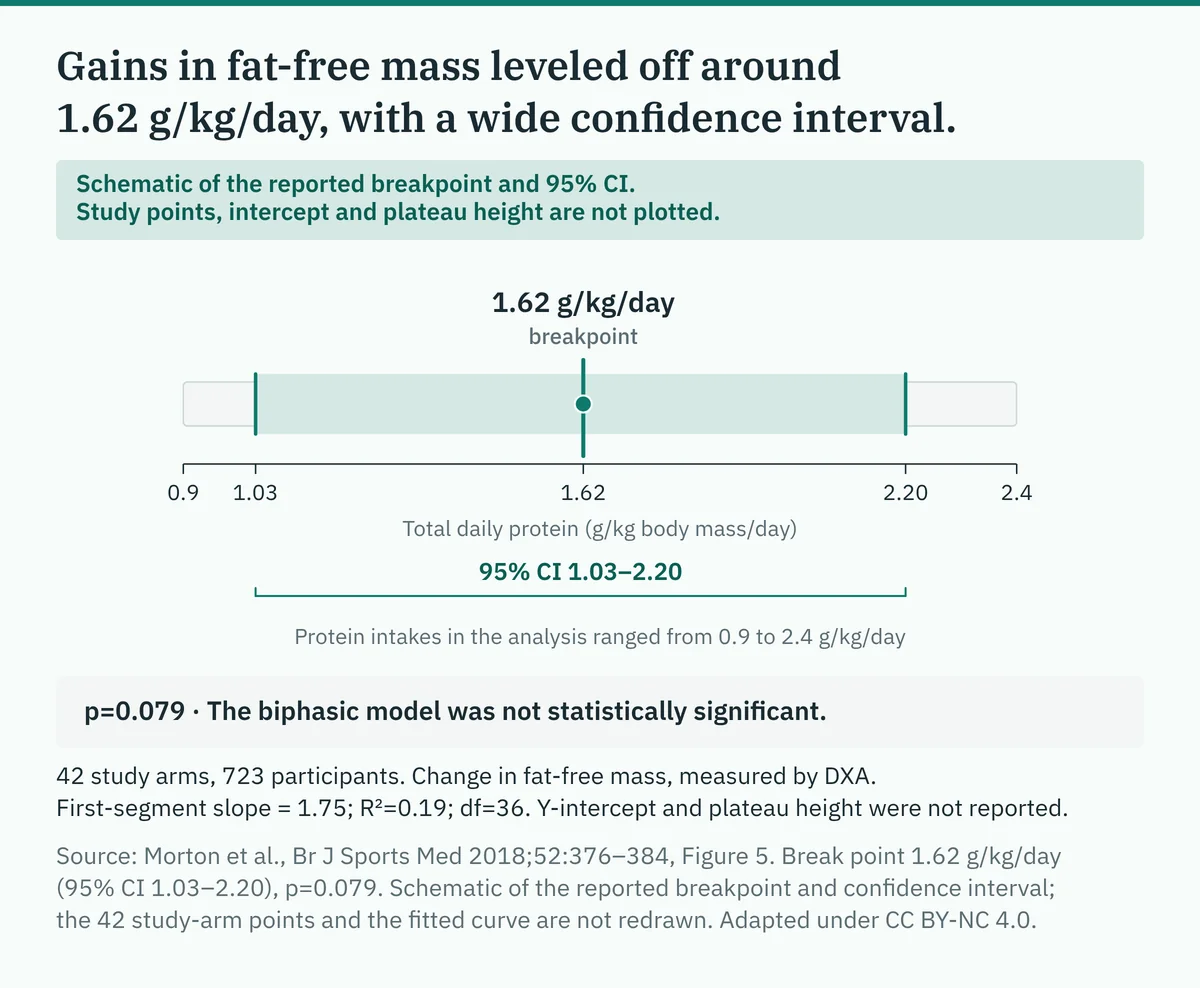
Daily dose-response. In 42 study arms (723 participants), fat-free-mass gains leveled off at a total daily intake of 1.62 g/kg/day (95% CI 1.03 to 2.20). The first-segment slope was 1.75, with R²=0.19. The biphasic model was not statistically significant (p=0.079). The authors still present ~1.6 g/kg/day as a practical figure, and they note that because the confidence interval runs up to 2.20, “it may be prudent to recommend ~2.2 g protein/kg/d for those seeking to maximise resistance training-induced gains in FFM.” Protein intakes in that analysis ranged from 0.9 to 2.4 g/kg/day.
Age. The extra fat-free mass from supplementation got smaller as age increased: −0.01 kg per year (95% CI −0.02 to 0.00, p=0.02 in the results table and figure). Split at 45 years, the added fat-free mass was 0.55 kg (0.30, 0.81) in younger adults (mean 24 ± 4 years) and 0.06 kg (−0.14, 0.26) in older adults (mean 67 ± 7 years). That difference between age groups was significant (p=0.003). The older-adult confidence interval crosses zero, so this dataset does not show a clear supplement benefit in that subgroup as studied. The authors point out that older groups were often given low doses (mean 20 ± 18 g/day), and that only 13 included trials enrolled people over 45.
Age did not change the effect of supplementation on 1RM strength.
Training status. Supplementation added more fat-free mass in resistance-trained participants: 1.05 kg (0.61, 1.50) versus 0.15 kg (−0.02, 0.31) in untrained participants (the untrained interval includes zero). In the authors’ planned meta-regression, training status was associated with an extra 0.75 kg (0.09, 1.40), p=0.03.
Timing and source. Post-exercise dose, protein source, and timing did not clearly change the fat-free-mass result. The authors conclude that those details “play a minor, if any, role” over a period of weeks, compared with total daily intake.
Per meal: older men needed more
Morton’s analysis is about total protein across the day, not how to split it. Two other papers, checked on PubMed, speak to per-meal amounts.
Moore et al., 2015 (The Journals of Gerontology: Series A). This was a retrospective analysis of six prior studies from the authors’ labs. They measured myofibrillar protein synthesis for 3–4 hours after a single bolus of high-quality, rapidly digested protein (whey in five studies, egg in one; doses 0–40 g) in healthy men who had not exercised for at least 48 hours. Even when a parent study included exercise, only the resting responses were used.
- 43 older men, mean age 71 years (range 65–80), and 65 younger men, mean age 22 years (range 18–37). Mean body mass was similar (~79–80 kg).
- Synthesis plateaued at 0.40 ± 0.19 g/kg of body mass in the older men and 0.24 ± 0.06 g/kg in the younger men. Those ± figures are 95% confidence intervals (0.21–0.59 and 0.18–0.30 g/kg). The difference was p=0.055 — just short of the usual 0.05 cutoff.
- Relative to lean mass, the plateaus were 0.60 ± 0.29 vs 0.25 ± 0.13 g/kg, and that difference was significant (p<0.01).
- Basal synthesis rates did not differ. The rise toward the plateau was shallower in the older men.
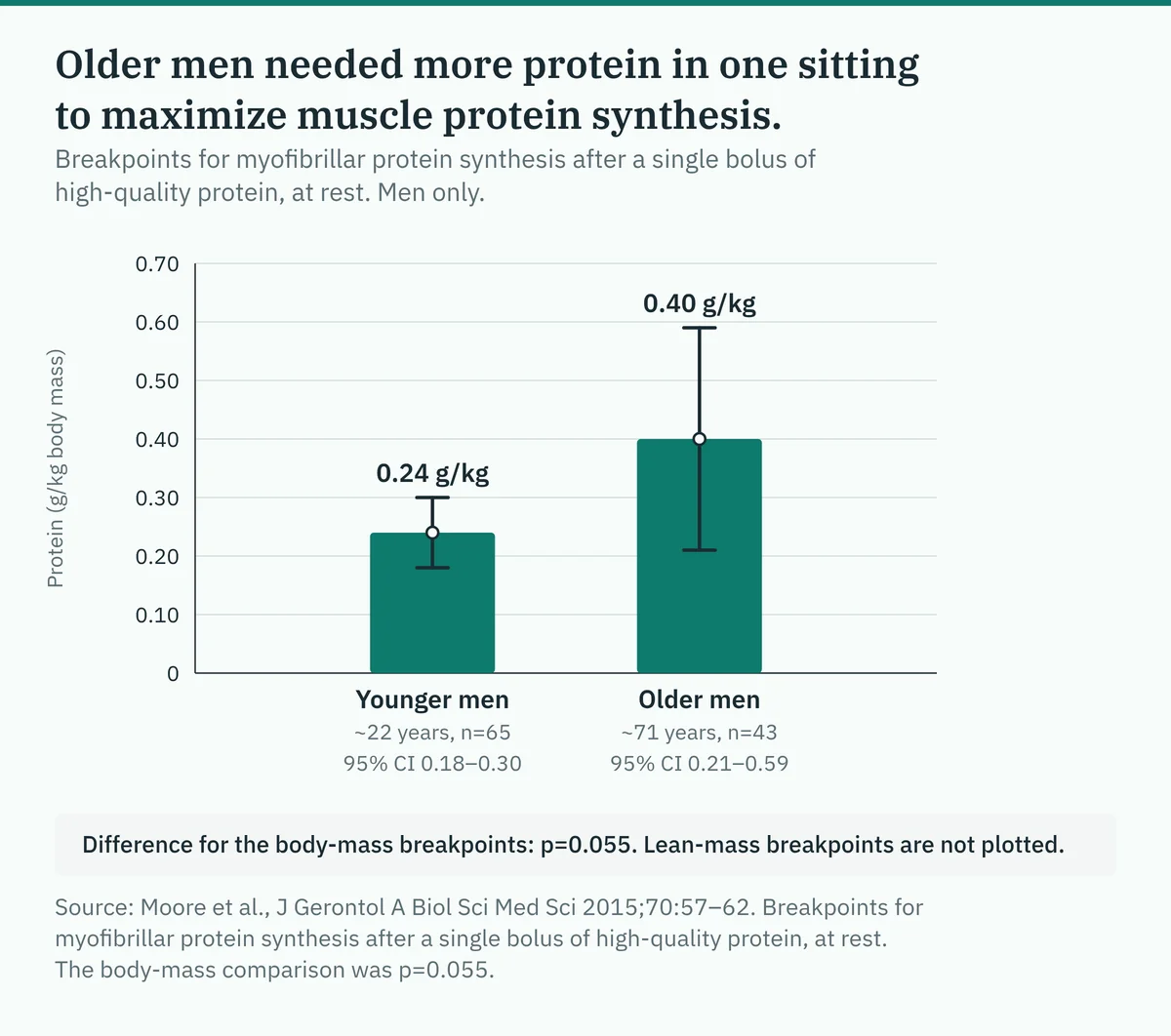
This is an acute, resting measurement in men only, not a long training study, and it used isolated fast proteins rather than mixed meals.
Schoenfeld and Aragon, 2018 (Journal of the International Society of Sports Nutrition). This is a narrative review, not a new trial. The authors argue that the common “20–25 g and the rest is wasted” idea comes mainly from fast proteins eaten alone, and that higher amounts can still be used for tissue building, especially in mixed meals. Drawing on Morton’s daily figures, they conclude that a practical target is 0.4 g/kg per meal, across at least four meals, to reach at least 1.6 g/kg/day. Using Morton’s upper 95% confidence interval of 2.2 g/kg/day over the same four meals would be 0.55 g/kg per meal. They are clear that 1.6 g/kg/day “should not be viewed as an ironclad or universal limit.”
For scale only (our arithmetic, not a recommendation): at 80 kg, 1.6 g/kg/day is 128 g, and 2.2 g/kg/day is 176 g. Moore’s per-meal plateaus would be about 19 g in the younger men and 32 g in the older men. Schoenfeld and Aragon’s 0.4 g/kg four times a day is also 128 g.
Limits
- The 1.62 g/kg/day breakpoint is an estimate, not a hard ceiling. The confidence interval is wide (1.03–2.20), the model was not statistically significant (p=0.079), and R² was only 0.19. It is a study-level fit, not a personal requirement.
- “Older” here is not 35. Morton’s older subgroup was over 45, with a mean age of 67 ± 7 years. Moore’s older men averaged 71. A lifter who is 35 or 40 sits closer to the younger Morton group (mean 24) than to those older groups. “Over 35” is our audience, not a separate physiology the papers isolated.
- Older groups were often underdosed. Only 13 Morton trials enrolled people over 45. Only six of those reported baseline protein intake with fat-free-mass changes, and only two gave a post-exercise dose the authors considered close to optimal for older adults (~35–40 g). The weak supplement effect in older adults may reflect those doses, not a lack of need for protein.
- Energy deficit was excluded. These daily targets do not apply to a cut. Our calculator uses a higher range, from a different source, when you choose “lifting while eating less.”
- Fibre-area result was fragile. Including one extra study removed the significant effect on muscle-fibre cross-sectional area.
- Search ran to January 2017. Later trials are not in the pool.
- Moore is acute and male-only, at rest, with isolated high-quality protein. It cannot tell you what a mixed meal does after training, or what happens in women.
- Schoenfeld and Aragon is a narrative review, offering a practical split of Morton’s daily numbers, not a new dose-finding trial.
- Conflicts. Phillips discloses grant support, travel expenses, and honoraria from the US National Dairy Council, which also funded some of the trials in the meta-analysis. A 2020 correction (PMID 32943392) added that Schoenfeld was on the advisory board of Dymatize Nutrition, a supplement manufacturer, when Morton et al. was written, and that he continued to serve on that board. The correction did not change any results.
What this does not mean
- It does not mean 1.6 g/kg/day is a magic number, or that protein above that is wasted.
- It does not mean protein powder is required if your food already reaches the daily total.
- It does not show that protein supplementation is as important as the lifting. In this analysis, training accounted for most of the change in strength and fat-free mass.
- It is not evidence that protein treats, prevents, or cures sarcopenia or any other medical condition.
- It does not set a special protocol that starts on your 35th birthday, and it says nothing about safety in kidney disease.
What it means for you
Verdict: if you lift and you are past 35, a reasonable daily target is still about 1.6 g of protein per kilogram of body weight, from food plus any powder. That is the midpoint our creatine and protein dose calculator uses in its “training to gain or keep muscle” range. Because Morton’s confidence interval runs up to 2.2 g/kg/day, sitting a bit higher is consistent with the same paper if your goal is to maximize fat-free-mass gains. Hitting the daily total, spread across meals, matters more than the exact timing of a shake.
If you are closer to 65 or 70 than to 35, Moore’s data support a larger serving of high-quality protein at each meal (around 0.40 g/kg in that older group) rather than several very small hits. Schoenfeld and Aragon’s 0.4 g/kg, four times a day, is one way to reach 1.6 g/kg without relying on a single large sitting.
Protein is the support act. The training is the main event. If you are also choosing a powder, creatine monohydrate has the more consistent training evidence in men in this age range: creatine monohydrate for men over 35. If you buy a protein or creatine product in Canada, a licence number is a separate question from the dose: how to read a Health Canada NPN.
This research post has no product links.
Sources
- Morton RW, Murphy KT, McKellar SR, Schoenfeld BJ, Henselmans M, Helms E, Aragon AA, Devries MC, Banfield L, Krieger JW, Phillips SM. A systematic review, meta-analysis and meta-regression of the effect of protein supplementation on resistance training-induced gains in muscle mass and strength in healthy adults. Br J Sports Med. 2018;52(6):376–384. doi:10.1136/bjsports-2017-097608. PMID 28698222. PMC5867436.
- Correction to Morton et al. 2018 (conflict-of-interest disclosure only). Br J Sports Med. 2020;54:e7. doi:10.1136/bjsports-2017-097608corr1. PMID 32943392.
- Moore DR, Churchward-Venne TA, Witard O, Breen L, Burd NA, Tipton KD, Phillips SM. Protein ingestion to stimulate myofibrillar protein synthesis requires greater relative protein intakes in healthy older versus younger men. J Gerontol A Biol Sci Med Sci. 2015;70(1):57–62. doi:10.1093/gerona/glu103. PMID 25056502.
- Schoenfeld BJ, Aragon AA. How much protein can the body use in a single meal for muscle-building? Implications for daily protein distribution. J Int Soc Sports Nutr. 2018;15:10. doi:10.1186/s12970-018-0215-1. PMID 29497353. PMC5828430.
Medical disclaimer
The Level Scoop is not a physician, pharmacist, or dietitian service and does not know your medical history. This article summarizes published research; it is not medical advice and is not a claim that protein supplements treat, prevent, or cure any condition. If you have kidney disease, are pregnant or breastfeeding, or have been told to limit protein, talk with a clinician before changing how much protein you eat or adding a supplement. Read our full medical disclaimer.